
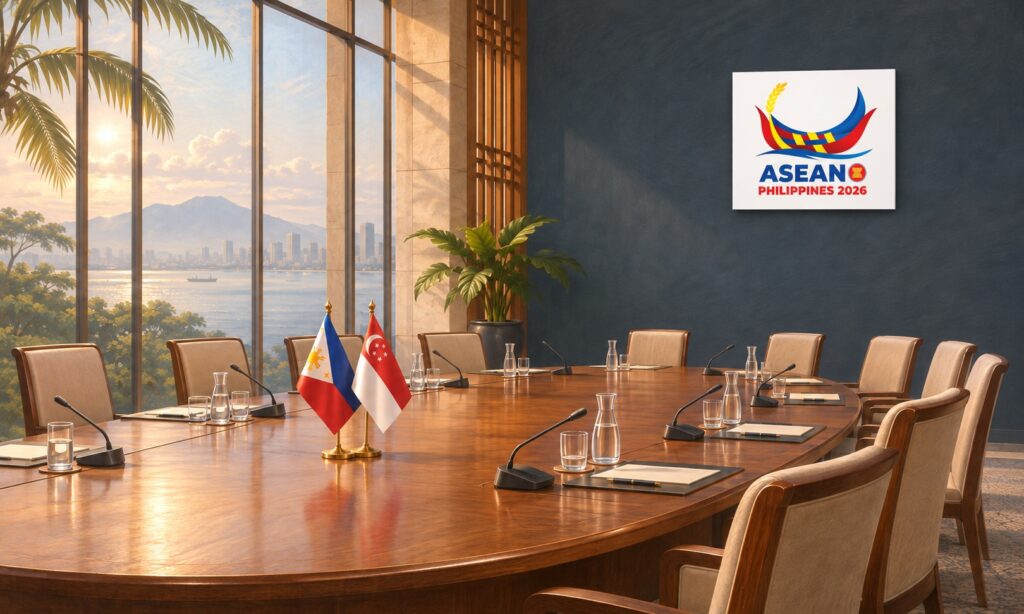
MANILA, Philippines — The Philippines will hand ASEAN’s chairmanship to Singapore on Tuesday with its most ambitious security initiative unfinished. At the 49th ASEAN summit, which opened Sunday, Philippine Foreign Secretary Theresa Lazaro said Southeast Asian countries and China had provisionally agreed on about 80 percent of a proposed South China Sea code of conduct. Negotiations will continue in 2027, with the code’s geographic reach and legal force still in dispute.
The hardest questions at sea
The remaining provisions will determine where the code applies and what obligations governments assume when their vessels encounter one another. Manila wants a code consistent with the United Nations Convention on the Law of the Sea. Beijing rejects a 2016 arbitral ruling that found no legal basis for its claims to historic rights to resources across much of the sea. Collin Koh, a maritime security scholar in Singapore, told Reuters that disagreements within ASEAN over the code’s geographic scope had also slowed negotiations. Separately, ASEAN ministers approved plans for a maritime cooperation center in the Philippines and recognized the ASEAN Coast Guard Forum as a formal regional body.
A conditional opening for Myanmar
ASEAN retained its restrictions on political representation from Myanmar at summits and foreign ministers’ meetings. Leaders said they would consider a gradual return if Myanmar made sustained progress on the bloc’s 2021 peace plan, which calls for an end to violence, dialogue and humanitarian aid. The decision follows a push by Thailand for greater engagement with Myanmar’s military-backed government, even as fighting and displacement continue.
Digital trade moves ahead as energy costs bite
ASEAN members signed a digital economy agreement on Saturday covering cross-border data flows, electronic trade documents and cooperation on online scams. With disruption in the Middle East squeezing fuel importers, leaders also called for faster work on a regional power grid. Singapore’s prime minister, Lawrence Wong, urged members to ratify the ASEAN Petroleum Security Agreement, and companies signed letters of intent to explore emergency oil access for the Philippines through storage facilities in Indonesia and Thailand.
For President Ferdinand Marcos Jr., the domestic stakes include fuel and food prices and the cost of hosting the bloc. The Philippine government allocated ₱22.9 billion for its yearlong chairmanship and says it will disclose actual spending for audit.
Partners look for wider trade ties
Chinese Premier Li Qiang arrived Sunday, with Beijing seeking early implementation of an upgraded trade pact with ASEAN. Canada announced that it had concluded bilateral trade negotiations with the Philippines and largely completed talks on a separate ASEAN-wide agreement. President Donald Trump is expected at Tuesday’s U.S.–ASEAN meeting, as governments in Manila look to broaden their trading relationships amid higher U.S. tariffs.
Sources: Philippine News Agency
Picture: AI Generated