
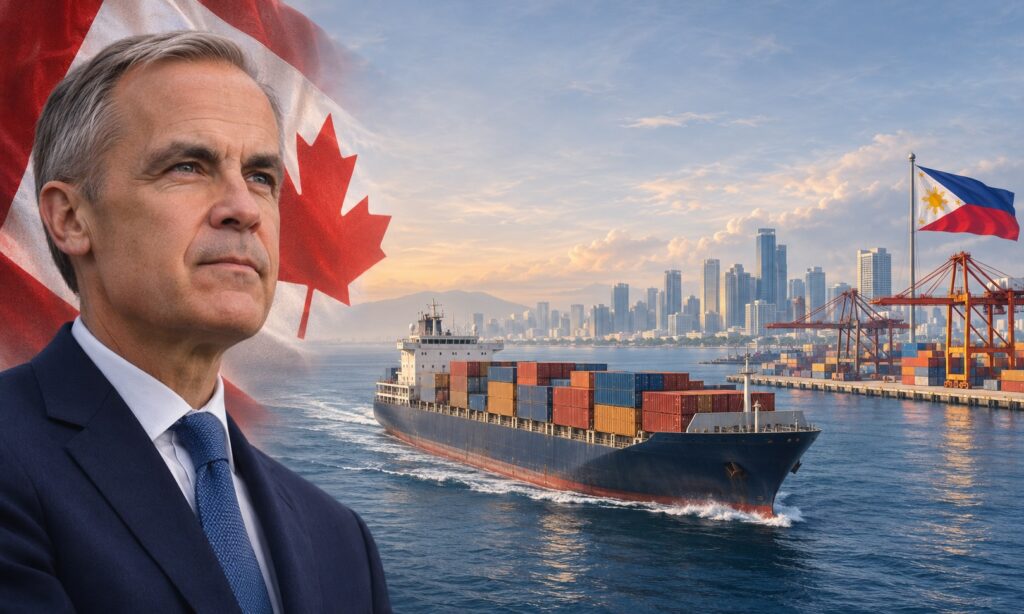
MANILA, Philippines – Prime Minister Mark Carney’s planned visit to Manila this month will test whether Canada can translate its campaign for broader economic partnerships into substantial new trade agreements.
During a November 11–19 tour of Ireland, the Philippines, Cambodia and China, Mr. Carney will seek to conclude negotiations with both the Association of Southeast Asian Nations and the Philippines. His office’s announcement sets an ambitious timetable, but neither agreement has yet been completed.
The economic stakes extend beyond Southeast Asia. Canada still sent 71.7 percent of its merchandise exports to the United States in 2025, according to Statistics Canada. Although that share declined from the previous year, it underscores how much work remains before alternative markets can substantially reduce Canada’s dependence on its southern neighbor.
Two Agreements, Different Opportunities
Ottawa says an ASEAN agreement could unlock more than C$3.5 billion in export opportunities. A September government assessment estimated a potential gain of nearly C$2 billion to Canadian gross domestic product. Separately, the government projects that a Philippine agreement could triple bilateral trade by 2035. These are prospective benefits, dependent on the agreements’ final terms and implementation.
For Manila, the bilateral negotiations offer the prospect of its first free trade agreement with a North American country. Philippine trade undersecretary Allan Gepty said in September that few issues remained, while emphasizing the difficulty of securing broad tariff concessions, particularly for sensitive agricultural products. Philippine negotiators are seeking the widest possible duty-free access for their exporters.
The regional agreement carries a broader strategic purpose. In their September joint statement, ASEAN and Canadian economic ministers linked closer cooperation to geopolitical tensions, disrupted supply chains and volatile energy markets. They called for negotiations to conclude at November’s summit, while identifying 2027 as the planned signing date — a distinction between a negotiating breakthrough and an agreement ready to deliver benefits.
The Difficult Work Beyond the Summit
Canadian business and policy discussions suggest that the remaining obstacles are consequential. An October 28 report from the Asia Pacific Foundation of Canada identified market access and rules of origin — which determine whether products qualify for preferential treatment — among the unresolved questions.
The report also highlighted a domestic challenge: Canadian companies need stronger knowledge of Southeast Asian markets, sustained commercial relationships and better east-west transportation corridors to capitalize on new access. Its assessment points to a practical limit on summit diplomacy: lower tariffs create opportunities, but businesses still need the capacity to pursue them.
Trade Minister Maninder Sidhu has presented the strategy as a durable economic priority. In September, he told Reuters that diversification had always been Canada’s plan and was not primarily a response to changes in American trade policy. That position makes the Manila negotiations a test of sustained commercial engagement as well as political momentum.
A Wider Diplomatic Balancing Act
The rest of Mr. Carney’s itinerary illustrates the breadth of that approach. Dublin offers an opportunity to advance closer European ties; Cambodia’s Francophonie summit reinforces cultural diplomacy; and the APEC meeting in Shenzhen provides another opening for economic engagement with China.
The European initiative also reveals the distance between ambition and settled policy. Although Mr. Carney has promoted Canada as a prospective EU “associate member,” Reuters reported that the designation remains contested among European governments, has no established legal meaning and was omitted from the October summit’s final statement.
Manila offers a more concrete measure of progress: whether negotiators can settle the remaining commercial terms and establish a credible path to implementation. For Canada, the eventual test will be whether exporters turn that access into orders, investment and a broader customer base.
Photo: AI Generated